

Table of Contents
- Fresh Roasted Coffee vs Koffee Kult: What Sets Them Apart
- Freshness of Coffee Beans: Roast Dates and Shelf Life
- Roast Profiles: Light vs Medium Roast Coffee Explained
- Koffee Kult Coffee Review: What Customers Actually Get
- Sourcing, Single Origins, and Coffee Bean Selection
- How to Store Whole Bean Coffee and Preserve Freshness
- Pricing Breakdown and Value Comparison
- Which Option Wins for Your Brewing Method
- Frequently Asked Questions
Last Updated: October 18, 2026
Fresh Roasted Coffee vs Koffee Kult: What Sets Them Apart
When you're looking for specialty coffee that actually tastes noticeably better than grocery store beans, the choice in fresh roasted coffee vs koffee kult matters more than you might think. The difference between a bag roasted three weeks ago and one roasted three days ago isn't just marketing, it's chemistry. Fresh roasted coffee loses its peak flavor window quickly, which is why roast-to-order models have become the gold standard for serious coffee drinkers.
At Saltwood Coffee, we've spent years understanding what separates truly fresh specialty coffee from the rest. The real comparison isn't just about brand names, it's about how coffee is roasted, when it ships, and what you're actually paying for peak freshness. Many coffee enthusiasts have been ordering from the same roaster for years without realizing there are meaningful differences in freshness guarantees, sourcing transparency, and value.
Here's what matters most: roast date transparency, shipping speed, single-origin bean quality, and whether you're getting coffee at its actual peak or past it. We'll walk you through exactly how fresh roasted coffee options stack up across these factors so you can decide which approach fits your routine.
Freshness of Coffee Beans: Roast Dates and Shelf Life
The freshness of coffee beans is determined by one critical factor: the roast date. Coffee begins degassing immediately after roasting, releasing carbon dioxide that protects the beans' oils and flavors. Within the first 24-48 hours, the coffee is still too active for optimal extraction. By day 3-5, you hit the sweet spot where degassing has slowed enough for balanced brewing but the beans retain their full flavor complexity. This window stays open for roughly 2-6 weeks depending on storage and roast style.
Most specialty roasters ship within 24-48 hours of roasting to hit that day-5-to-day-14 window when you brew it at home. Some roasters print roast dates on every bag. Others are vague about timing, which means you have no way to know if you're drinking peak-freshness coffee or something that's been sitting in a warehouse for three months.
The practical difference shows up in your cup. Coffee past its peak tastes flat, slightly stale, or one-dimensional. Peak-freshness coffee tastes bright, balanced, and reveals the specific flavor notes the roaster intended, whether that's citrus acidity, chocolate body, or floral aroma. If you've only ever had grocery store coffee, the upgrade is noticeable. If you're switching between roasters, roast date transparency becomes your most reliable quality signal.
Whole bean coffee stays fresher longer than ground coffee because grinding dramatically increases surface area, accelerating oxidation. Whole beans in a sealed bag with a one-way valve can maintain quality for 4-6 weeks. Ground coffee peaks within 2-3 weeks and degrades faster after opening.
Roast Profiles: Light vs Medium Roast Coffee Explained
Light roast coffee is pulled from the roaster earlier in the process, typically before the "first crack", when beans expand and snap from internal pressure. Light roasts preserve more of the bean's origin characteristics, meaning you taste more of the specific region's terroir: bright acidity, floral or fruity notes, and the unique flavor profile that comes from where the coffee was grown.
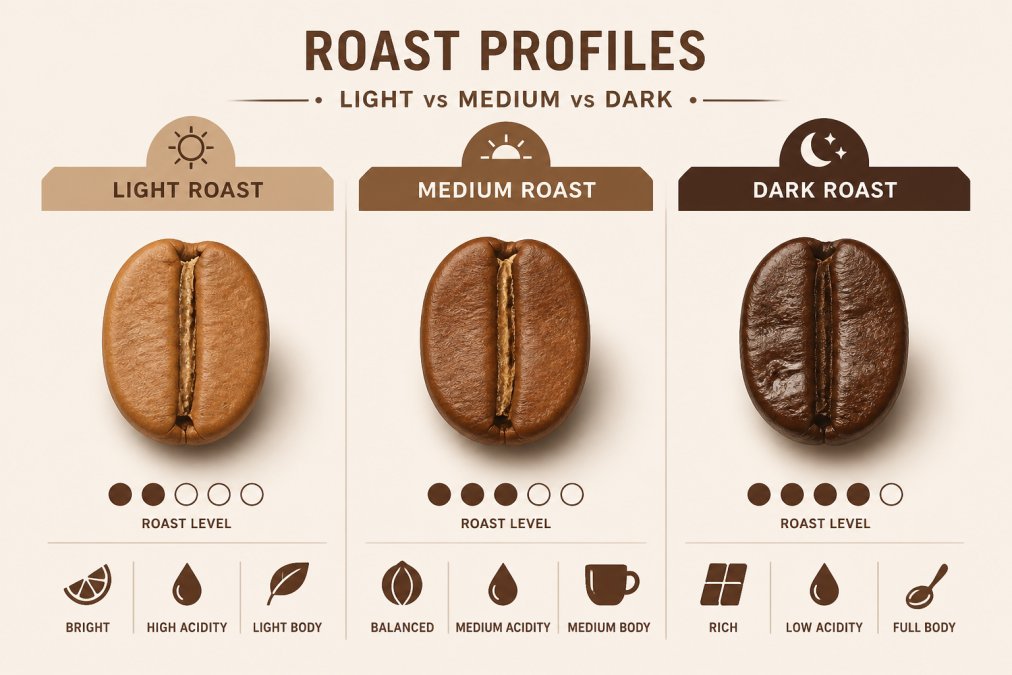
Medium roast coffee passes through the first crack and stops before the second crack. This is where most specialty coffee lives. Medium roasts balance origin character with roast development, you still taste where the coffee came from, but the roasting process adds depth, body, and sometimes caramel or chocolate notes.
Dark roast coffee goes past the second crack, developing deeper roasted flavors like dark chocolate, molasses, and sometimes spice. Dark roasts have less acidity and heavier body. They're excellent for espresso because the roasted flavors hold up to milk and pressure. Many coffee drinkers assume dark roast means "stronger," but that's a myth, strength is about coffee-to-water ratio, not roast level.
The choice between light and medium roast comes down to what you want to taste. Light roasts reward curiosity about origin and brewing precision. Medium roasts offer consistency and balance. Dark roasts deliver bold, roasted flavors that pair well with milk.
Koffee Kult Coffee Review: What Customers Actually Get
The trade-off is price. Specialty roast-to-order coffee costs more per bag than supermarket alternatives. Koffee Kult sits in the mid-to-premium tier for specialty roasters, which means you're paying for freshness and quality but not at the absolute lowest specialty price point.
Sourcing, Single Origins, and Coffee Bean Selection
Single-origin coffee means all the beans in the bag come from one specific region, often one specific farm or cooperative. This gives roasters and buyers complete traceability, you know exactly where the coffee came from, how it was processed, and what altitude it was grown at.
Blends combine beans from multiple origins to create consistent flavor profiles. A well-designed blend balances acidity, body, and flavor complexity across multiple regions. Blends are often easier to brew consistently because they're formulated to work across different brewing methods and water types.
Sourcing transparency matters because it tells you whether a roaster is buying from commodity suppliers or direct relationships with growers. Direct-trade and fair-trade certifications indicate the roaster is paying growers premium prices and maintaining long-term relationships. This typically results in higher quality beans and more consistent flavor year to year.
Saltwood Coffee sources single-origin beans from specific growers and cooperatives across Central America, South America, Africa, and Asia. Our sourcing practices emphasize direct relationships with specialty growers to ensure traceability and consistency. Each origin has a documented grower, altitude, processing method, and tasting profile so you understand exactly what you're brewing.
For example, our Brazil Santos comes from Fazenda Santa Barbara in São Paulo, grown at 750-1050 meters altitude with volcanic loam soil. The beans are pulped naturally and sun-dried, which creates the elegant, smooth cup with cocoa notes that defines this origin. That specificity, grower name, altitude, process, tells you this is genuine single-origin coffee, not a generic "Brazilian blend."

How to Store Whole Bean Coffee and Preserve Freshness
Whole bean coffee stays fresher longer than ground coffee, but storage still matters enormously. The enemy of freshness is air, light, heat, and humidity. Your goal is to minimize exposure to all four.
The best storage method is an airtight container kept in a cool, dark place. Avoid clear glass jars near windows or kitchen lights. Avoid storing coffee above the stove or near heat sources. Room temperature or slightly cool (65-70°F) is ideal. Many coffee drinkers freeze whole beans in airtight containers to extend freshness, which works well if you thaw the entire container before opening, repeated thawing and refreezing creates condensation that damages beans.
Best Sellers Sample Pack: 6Bean, Cowboy, Breakfast, Peru, Mexico, Bali →
Once you open a bag of whole bean coffee, plan to use it within 2-4 weeks. After that window, the beans have absorbed moisture and oxidized noticeably. Ground coffee degrades faster, so grind just before brewing if possible.
The roast date on the bag tells you exactly when freshness started. If you see a bag with no roast date, that's a red flag, the roaster is hiding how old the coffee is. Transparent roasters always print the roast date because they're confident the coffee was roasted recently.
Pricing Breakdown and Value Comparison
Specialty roast-to-order coffee costs more than grocery store coffee. The question is whether the quality justifies the price.
Saltwood Coffee prices most single-origin and blend options at $24.99. Our sample packs, which let you try multiple roasts and origins, are also $24.99. This pricing reflects roast-to-order freshness — your coffee is roasted after you order and shipped the same day it's roasted.

The value calculation depends on what you're comparing against:
| Comparison | Cost Per Bag | Freshness Guarantee | Roast Date Transparency |
|---|---|---|---|
| Grocery store specialty | $8-12 | 2-6 months old | Usually missing |
| Mass-market online roasters | $12-18 | 1-3 months old | Often vague |
| Specialty roast-to-order | $22-28 | 3-7 days old | Always included |
The real cost difference is negligible when you factor in freshness. A $25 bag of peak-fresh specialty coffee tastes dramatically better than a $12 bag that's been sitting in a warehouse. Most coffee drinkers find that one excellent cup per day is worth the upgrade.
Where price matters is subscription commitment. If you're ordering regularly, you're paying the premium repeatedly. Roast-to-order models work best for people who brew coffee multiple times per week and value freshness enough to prioritize it over convenience.
Which Option Wins for Your Brewing Method
Different brewing methods extract coffee differently, which means different roasts and bean characteristics perform better with each approach.
Drip coffee makers work best with medium roasts and medium-fine grinds. Drip machines brew slowly, giving coffee time to extract fully. Medium roasts balance origin character with enough body to stand up to the brewing process.
French press brewing uses immersion, the coffee sits in hot water for 4 minutes. This method extracts bold flavors and shows coffee's body clearly. Medium-dark and dark roasts shine here because the extended contact time brings out roasted notes.
Espresso machines need finely ground coffee and pressure extraction. Dark roasts and espresso-specific blends work best because the roasted flavors hold up to milk and the pressure extraction. Light roasts can taste sour through espresso.
Pour-over methods (Chemex, V60, Kalita Wave) give you control over water temperature and pour rate. These methods reward medium and light roasts because they highlight origin character. The brewing process is precise, so freshness and roast date matter more than with drip machines.
If you're not sure which method you prefer, start with a medium roast through your current brewing setup. Our Best Sellers Sample Pack includes medium roasts like Peru and Mexico single origins plus our medium-roast Breakfast Blend, so you can test what works with your equipment.

The real difference between fresh roasted coffee options comes down to freshness guarantee, sourcing transparency, and whether you value peak flavor enough to prioritize roast-to-order shipping. Start with Saltwood Coffee's sample packs to experience what roast-to-order freshness actually tastes like.
Frequently Asked Questions
What's the actual difference between fresh roasted coffee and Koffee Kult?
Fresh roasted coffee emphasizes roasting after you order and shipping the same day it's roasted, to capture peak freshness within the first two weeks after roasting. The key difference in fresh roasted coffee options is roast-to-order timing: some prioritize the freshness window, while others focus on consistency and availability. Both use quality single-origin and blended beans, but the roast date transparency and delivery speed can differ significantly.
How long do freshly roasted coffee beans stay fresh?
Freshly roasted coffee beans reach peak flavor between 5 and 21 days after roasting. The coffee continues to degas and develop complexity during this window. After 4-6 weeks, beans begin to fade noticeably in brightness and aroma, though they remain drinkable for several months if stored properly. Roast date transparency lets you know exactly when your beans peaked, so you can brew them at the right time for maximum flavor and body.
Is freshly roasted coffee worth the extra cost compared to grocery store beans?
Yes, if you value flavor depth and aroma. Freshly roasted beans deliver noticeably brighter acidity, more pronounced tasting notes (citrus, chocolate, caramel), and fuller body than grocery store coffee, which is often months old. The difference is most obvious when brewing single-origin beans in a pour-over or French press, where water temperature and extraction time highlight the roast profile. For everyday drip coffee, the upgrade is still noticeable but less dramatic than for specialty brewing methods.
How do I know if coffee beans are actually fresh when they arrive?
Check the roast date printed on the bag, it should be no more than 2-3 weeks old for peak freshness. Fresh beans release more CO2 (degassing), so they may feel slightly puffy in the bag or show a one-way valve that bulges outward. When you open the bag, fresh coffee has a vibrant, complex aroma rather than a flat or musty smell. If the bag shows no roast date or the date is older than 4-6 weeks, the coffee has likely passed its optimal window.