

Table of Contents
- Light vs Dark Roast Coffee: Key Differences at a Glance
- How Roasting Time and Temperature Shape Each Roast
- Flavor, Acidity, and Body: What Your Palate Notices
- Light Roast vs Dark Roast Caffeine: What the Numbers Say
- Light Roast vs Dark Roast Espresso: Which Pulls Better Shots
- Which Coffee Roast Is Strongest? Strength vs Caffeine Explained
- How to Brew Light Roast Coffee (And Adjust for Dark Roast)
- Freshness, Storage, and Degassing: Why Roast Date Matters
- Frequently Asked Questions
Last Updated: October 5, 2026
Light vs Dark Roast Coffee: Key Differences at a Glance
The difference between light and dark roast coffee comes down to how long the beans stay in the roaster. Light roasts stop early, keeping bright acidity and origin flavors intact.
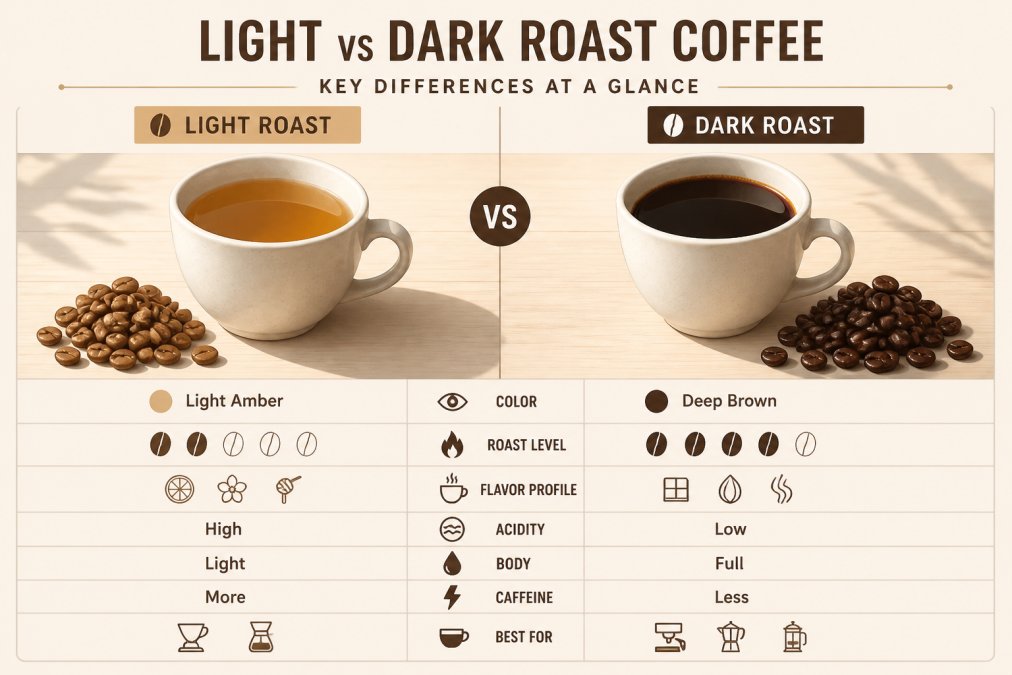
Here's the part most guides skip: roast level doesn't change how much caffeine is in your scoop the way people assume. It changes flavor, acidity, body, and how you should brew.
Quick Comparison Table
| Feature | Light Roast | Dark Roast |
|---|---|---|
| Roast time | Shorter, stopped near first crack | Longer, past second crack |
| Color | Tan to cinnamon brown | Deep brown, sometimes oily |
| Acidity | Higher, brighter | Lower, softer |
| Body | Lighter, tea-like | Heavier, syrupy |
| Flavor | Citrus, floral, fruity | Bittersweet, smoky, chocolatey |
| Caffeine by weight | Slightly higher | Slightly lower |
| Caffeine by scoop | Similar | Similar |
| Best brew method | Pour-over, drip, cold brew | Espresso, French press |
How Roasting Time and Temperature Shape Each Roast
Roasting time and temperature decide a bean's final character. Green beans enter the roaster at roughly 200°C, and roast level is set by when the roaster stops the process. Light roasts finish around 196-205°C internal bean temperature; dark roasts push past 225°C.
First Crack and Roast Development Stages
First crack is the audible popping sound beans make when moisture turns to steam and the bean structure splits open, usually around 196°C. This is where light roasts are typically dropped, or shortly after.
The stages that follow matter just as much:
- First crack: beans expand, moisture escapes, roast becomes drinkable
- Development time: the window after first crack where sugars caramelize and flavor deepens
- Second crack: a sharper, faster crackling around 225°C, marking the shift into dark roast territory
A common mistake is judging roast level by color alone. Two roasters can pull beans at the same temperature and get different colors depending on origin and density.
Flavor, Acidity, and Body: What Your Palate Notices
Flavor, acidity, and body are the three differences you'll notice first in the cup. Light roasts taste brighter and more fruit-forward because roasting hasn't burned off the bean's original character. Dark roasts taste deeper and more bittersweet because heat has transformed origin flavors into roast flavors.
Here's how each roast typically presents:
Light roast
- Acidity: high, perceived as brightness or a slight tang
- Body: light to medium, similar to tea
- Tasting notes: citrus, floral, berry, herbaceous
Dark roast
- Acidity: low, sometimes nearly absent
- Body: full and syrupy
- Tasting notes: dark chocolate, toasted nuts, smoke, caramelized sugar
Bean origin still matters inside each category. This is why Specialty Coffee Association guidance on roast and origin treats roast level and origin as two separate variables.
Light Roast vs Dark Roast Caffeine: What the Numbers Say
Light roast vs dark roast caffeine is the most misunderstood part of this comparison. Most guides stop at one sentence: "light roast has slightly more caffeine by weight, but it evens out by scoop." That's true, but it skips what actually changes your cup, the difference between caffeine in the bean and caffeine in the brewed coffee you drink.
Bean-Level Caffeine vs Brewed-Cup Caffeine
Caffeine in the green bean is essentially fixed by species and variety; roasting doesn't create or destroy meaningful amounts. What roasting changes is the bean's mass, density, and solubility, and those shift the numbers you see on a scale or in a lab test.
- Bean level (by weight): Light roast beans retain more mass after roasting, so a gram of light roast contains marginally more caffeine than a gram of dark roast, often just a few percent.
- Bean level (by volume): Dark roast beans expand and lose mass, so a scoop of dark roast weighs less than a scoop of light roast. The density difference roughly cancels the caffeine difference, so scoop-for-scoop the two land close together.
- Brewed cup: What reaches your mug depends on dose, grind, water temperature, brew ratio, and extraction. A light roast dosed at 18 g and brewed at 1:15 can deliver more caffeine than a dark roast dosed at 14 g and brewed at 1:17, even though the dark roast "wins" on some bean-level charts.
That third point is the one competitors miss: bean-level caffeine comparisons don't predict what's in your cup.
Why the Scoop vs Scale Distinction Matters
If you measure coffee with a scoop, you're measuring volume; with a scale, you're measuring mass. Those two methods give different answers for the same roast level.
A common pattern: switching from a level scoop of dark roast to a level scoop of light roast, with no other change, produces a cup that tastes stronger and feels more caffeinated, because the light roast scoop weighed more.
If caffeine is your goal, the levers that actually move the number are:
- Dose: more grams of coffee per unit of water means more caffeine.
- Bean species: Robusta contains roughly twice the caffeine of Arabica, so a Robusta blend can out-caffeinate any Arabica roast level.
- Grind and contact time: finer grind and longer contact extract more caffeine, up to the point of over-extraction.
Roast level is the wrong lever for caffeine. Dose, species, and brew method are the right ones.
A Simple Side-by-Side Caffeine Test
You don't need lab equipment to see how roast level interacts with measurement:
- Weigh a level scoop of light roast beans and a level scoop of dark roast beans separately. Note the gram weights.
- Brew each at the same dose by weight (for example, 18 g coffee to 270 g water), same grind, same water temperature.
- Taste both and note perceived strength and any jittery feeling over the next hour.
- Repeat with the same volume (one scoop each) instead of the same weight, and compare again.
The first round isolates roast level; the second shows how much the scoop-vs-scale choice changes the outcome. Most people find the scale method produces a more consistent cup regardless of roast.
Specialty Coffee Association resources on coffee measurement and brewing
Light Roast vs Dark Roast Espresso: Which Pulls Better Shots
Light roast vs dark roast espresso is a genuine trade-off, not a clear winner.
For espresso, here's what changes between the two:
- Dark roast: extracts faster, tolerates a coarser grind, produces thick crema and a bittersweet finish
- Light roast: needs a finer grind and higher water temperature, produces thinner crema and a brighter, fruitier shot
Our Italian Roast is built for this style of brewing. It's our darkest roast, a slow-roasted blend of specialty-grade Arabica and Robusta, and it holds up well under espresso pressure.

If you want a light roast that still works as espresso, our Blonde is roasted light to keep its natural sweetness up front and pulls a beautifully sweet shot.
Which Coffee Roast Is Strongest? Strength vs Caffeine Explained
Which coffee roast is strongest depends on what you mean by strong. If strong means bold flavor, dark roast wins. If strong means more caffeine, roast level barely matters. These two ideas get mixed up constantly, and it's the main reason people buy the wrong bag.
Strength in coffee usually refers to:
- Flavor intensity: dark roasts taste bolder because roasting creates heavier, more bitter compounds
- Body and mouthfeel: dark roasts feel thicker on the tongue
- Caffeine: determined mainly by dose, bean species, and brew method, not roast level
A light roast brewed at a strong ratio will hit harder than a dark roast brewed weak. If caffeine is your goal, weigh your coffee instead of scooping it.
How to Brew Light Roast Coffee (And Adjust for Dark Roast)
How to brew light roast coffee comes down to one principle: light roasts are denser and less soluble, so they need more help to extract fully. Dark roasts are more porous and soluble, so they extract faster and punish you if you push too hard. The table below is a starting point, the real skill is reading the cup and adjusting.
Grind Size, Water Temperature, and Brew Ratio
| Variable | Light Roast | Dark Roast |
|---|---|---|
| Water temperature | 93-96°C | 88-92°C |
| Grind size | Medium-fine | Medium-coarse |
| Brew ratio | 1:15 to 1:16 | 1:16 to 1:17 |
| Brew time | Slightly longer | Slightly shorter |
| Best methods | Pour-over, drip, cold brew | Espresso, French press, moka |
Start light roasts at 1:15 with water just off the boil. Start dark roasts at 1:16 with water a few degrees cooler. Then adjust by taste, not by the clock.
Troubleshooting: Sour Light Roast, Bitter Dark Roast
These two complaints cover most home-brewing problems and have opposite fixes.
Light roast tastes sour, thin, or grassy, this is under-extraction. The roast is dense and the water didn't pull enough out of it. Try, in order:
- Grind finer. This is the single biggest lever.
- Raise water temperature toward 96°C.
- Extend brew time or add a gentle stir during the pour.
- Increase dose slightly (for example, 18 g to 19 g) while keeping water the same.
Dark roast tastes bitter, ashy, or drying, this is over-extraction. The roast is porous and gave up its solubles fast. Try, in order:
- Grind coarser.
- Lower water temperature toward 88°C.
- Shorten brew time or reduce agitation.
- Decrease dose slightly (for example, 18 g to 17 g) while keeping water the same.
Change one variable at a time and taste after each change; changing three at once makes it impossible to know what worked.
A Controlled Side-by-Side Tasting Method
To actually taste the difference between a light and a dark roast, control everything except the roast level. This is the method most roasters use internally, and it's easy to replicate at home:
- Same dose by weight. Weigh 15 g of each roast on the same scale.
- Same grind setting. Use the same grinder setting for both, even if it's not ideal for one of them. You're isolating roast, not optimizing each cup.
- Same water temperature. Pick one temperature, 93°C is a reasonable middle ground, and use it for both.
- Same brew ratio and time. 1:16, same pour schedule, same total time.
- Taste blind if you can. Have someone else label the cups A and B so you're not primed by what you expect.
You'll likely notice the light roast reads brighter and more acidic, the dark roast heavier and more bittersweet, with an obvious body difference. That's roast level showing up in the cup, separated from origin and brew variables.
Our Sunrise Breakfast Blend is a lightly roasted blend of South American coffees with tasting notes of walnuts, mild apple, slight raisin, and toffee. It works across brew methods, which makes it a good starting point if you're learning to brew light roast at home.

Freshness, Storage, and Degassing: Why Roast Date Matters
Freshness and storage decide whether your roast level shows up in the cup. Beans release carbon dioxide for days after roasting, degassing (pubmed.ncbi.nlm.nih.gov). Brew too soon and escaping gas disrupts extraction; wait too long and the beans go flat.
A practical timeline:
- Days 1-3 after roast: heavy degassing, best for espresso if you like a thick crema
- Days 4-14: peak flavor window for most brew methods
- Weeks 3-6: flavor starts to fade, especially in light roasts
Store beans in an airtight container away from light, heat, and moisture. Skip the freezer unless storing a large batch long-term, and never leave beans in a grinder hopper for weeks.
This is why roast date transparency matters more than almost any other label. Our French Roast is a deep dark roast of high-scoring African coffees with bittersweet flavor and low acidity, and our 6 Bean Blend is a dark house blend built for espresso.

Frequently Asked Questions
Does light roast coffee have more caffeine than dark roast?
By weight, yes, but only slightly. Light roast beans are denser because they lose less moisture during roasting, so a scoop of light roast contains more bean mass and therefore more caffeine than the same scoop of dark roast. When measured by weight on a scale, the difference between light vs dark roast is small. Because most people scoop rather than weigh, the practical gap often comes down to how you measure, not the roast itself.
Which coffee roast is strongest in flavor?
Dark roasts taste stronger because roasting longer develops bitter, smoky, and bittersweet notes while reducing acidity. A French Roast or Italian Roast delivers that bold, heavy cup many people associate with strength. Light roasts taste brighter and more acidic, with citrus, floral, or herbaceous notes that read as delicate rather than intense. Strength in flavor is a preference, not a ranking.
Which roast is better for espresso?
Both work, but they need different adjustments. Dark roasts like Saltwood's 6 Bean Blend extract easily and pull rich, syrupy shots with low acidity. Light roasts like Blonde need a finer grind, higher water temperature, and a longer ratio to extract fully, and they reward you with a sweet, fruit-forward espresso. If you want a forgiving starting point, choose dark; if you want to experiment, try light.
How should you brew light and dark roast coffee differently?
Light roasts are denser and less soluble, so use water just off the boil (around 96°C), a finer grind, and a slightly longer brew time to pull out sweetness. Dark roasts are more porous and extract quickly, so drop the water temperature to about 90-92°C, use a coarser grind, and shorten the brew to avoid bitterness. Adjust one variable at a time and taste before changing the next.
How does light roast taste different from dark roast?
Light roast keeps the bean's origin characteristics intact, so you taste citrus, floral, or herbaceous notes with higher acidity and a lighter body. Dark roast masks those origin flavors with roast-driven notes: bittersweet chocolate, smoke, and caramel, with low acidity and a heavier mouthfeel. Neither is better; they simply highlight different parts of the coffee.
Choosing a roast level is really a choice about how you want your morning to taste. Light roasts reward attention with brightness and origin character. Dark roasts deliver bold, low-acidity comfort with less fuss. Saltwood Coffee roasts to order and ships the same day it's roasted, so whichever direction you pick, the beans reach you near their peak freshness window. Start the Ritual and taste the difference a real roast date makes.