

Table of Contents
- Why Roast Date Matters for Coffee Freshness and Flavor
- Coffee Roast Date vs Expiration Date: What's the Difference?
- How Long After Roasting Is Coffee Best?
- How to Store Coffee Beans for Lasting Freshness
- Signs Coffee Beans Are Stale (and What to Do)
- How Roast Level and Bean Type Affect Freshness
- A Buyer's Checklist: Choosing Coffee by Roast Date
- Conclusion
- Frequently Asked Questions
Last Updated: October 7, 2026
Why Roast Date Matters for Coffee Freshness and Flavor
Most kitchen coffee bags carry a best-by date stamped a year out, a number that tells you almost nothing. For real coffee freshness, the roast date is the only number that counts. Here's why, and how to use it.
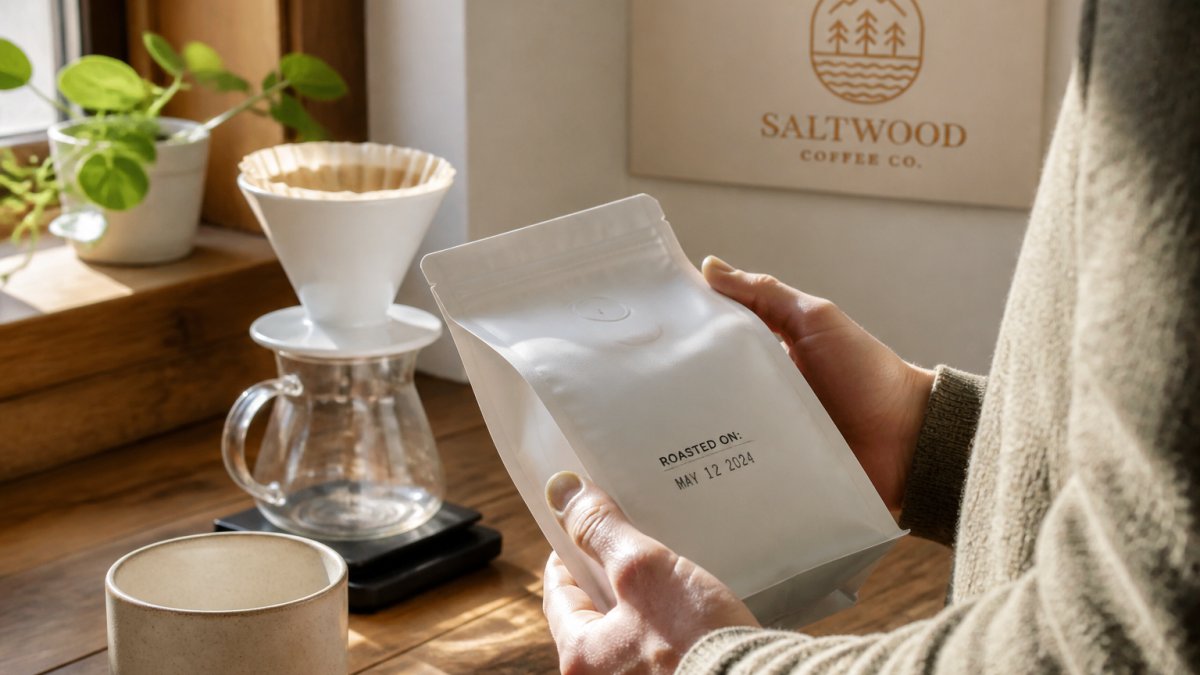
Coffee tastes best in the first few weeks after roasting.
Freshness isn't a switch that flips from "good" to "bad", it's a slow slide, and knowing where your bag sits on it changes how you brew.
Below: how to read a coffee bag, how long coffee stays fresh, and how to store it so the last cup tastes as good as the first.
What Happens to Coffee After Roasting
Roasting transforms green coffee into brown beans and traps carbon dioxide inside each one. That gas slowly escapes over days and weeks, a process called degassing.
As CO2 leaves, oxygen moves in. It dulls aroma, flattens flavor, and turns bright notes cardboard-like, which is why roasted coffee is a perishable product, not a pantry staple.
The clock starts at roast, not at purchase. A bag that sat on a shelf for months is already behind.
Coffee Roast Date vs Expiration Date: What's the Difference?
The roast date tells you when the beans were roasted. The expiration or best-by date tells you when a retailer thinks the bag is no longer sellable. Two very different things.
A best-by date is set for shelf stability, not peak flavor, and can sit a year or more past roast. By then the coffee is safe but tastes flat.
The roast date, by contrast, is a freshness marker: how many days the beans have rested and how much life is left.
How to Read the Date on a Coffee Bag
Look for a stamped or printed date near the bottom or back of the bag, clearly labeled "Roasted On."
- Roasted On: the date the beans left the roaster. This is the one you want.
- Best By: a sell-by or quality window, often set far out.
- Julian codes: some bags use a three-digit day code. Ask the roaster to decode it.
If the date is vague or missing, treat the coffee as a gamble. Transparency marks a roaster who trusts their product.
How Long After Roasting Is Coffee Best?
Most coffee hits its peak flavor window between a few days and a few weeks after roasting, depending on roast level and brew method.
Freshly roasted coffee needs a short rest. Brew too soon and trapped CO2 fights your water, causing uneven extraction and a sour, gassy cup; wait too long and oxygen steals the good stuff.
So "fresh" doesn't mean "as soon as possible." It means the sweet spot after degassing and before flavor fade.
Degassing and the Resting Period
Degassing is the release of carbon dioxide from roasted beans, starting right after roasting and slowing over time.
A common approach is resting beans a few days before brewing; lighter roasts need longer than darker ones. During this window the beans settle and flavors come together.
Flat or sour right after opening? It may need another day or two. Dull and lifeless? It's likely past its window.
Peak Flavor Window by Brew Method
Brew methods handle freshness differently. A practical timeline:
| Brew Method | Best Resting Time | Peak Flavor Window |
|---|---|---|
| Espresso | 5-10 days | 1-3 weeks |
| Pour-over | 3-7 days | 1-4 weeks |
| French press | 3-7 days | 1-4 weeks |
| Cold brew | 5-14 days | 2-6 weeks |
These are guides, not rules. Your taste buds are the final judge.
How to Store Coffee Beans for Lasting Freshness
Storing coffee well isn't about one magic container, it's about controlling four enemies: oxygen, heat, light, and moisture.
Oxygen is the primary driver of staling, reacting with and oxidizing the bean's oils and aromatic compounds.
Heat accelerates every chemical reaction, including oxidation. A bag by the stove or on a sunny windowsill fades faster than one in a cool pantry.
Light breaks down aroma compounds. Opaque containers or foil-lined bags protect against it; clear glass jars on an open shelf let light in every day.
Moisture is subtler. Beans are hygroscopic, absorbing water from the air; in a humid kitchen that dulls flavor and can promote mold. Keep beans sealed when not in use.
Practical Storage After Opening
Once you open a bag, the clock speeds up. A simple routine for most home brewers:
- Keep beans in the original bag if it has a one-way valve and a resealable top. The valve lets CO2 escape without letting oxygen in, and the foil layer blocks light. Roll the top down and clip it, or use the built-in zipper.
- If you transfer to a container, choose an airtight, opaque one. A ceramic canister with a rubber gasket or a stainless steel vacuum container works well. Avoid clear glass unless you store it in a dark cabinet.
- Store at room temperature, away from the stove, oven, and direct sun. A pantry shelf or closed cabinet is ideal.
- Do not store beans in the fridge. The fridge is humid and full of odors that coffee can absorb. Condensation when you take the bag out can also introduce moisture.
- Freeze only if you seal airtight and use straight from frozen. For long-term storage, portion beans into airtight bags or vacuum-sealed jars, freeze them, and grind them while still frozen to avoid condensation. This works best for beans you will not open for weeks.
- Buy amounts you will finish within two to four weeks. A smaller bag you finish fresh beats a bulk bag that fades before you reach the bottom.
The Role of the One-Way Valve
Many coffee bags have a small one-way valve on the front. It lets CO2 escape without letting oxygen in. This keeps the bag from puffing up and protects the beans during shipping and on the shelf.
The valve helps, but it is not a seal against time. Once you open the bag, oxygen gets in every time you reach for a scoop. Reseal it tightly after each use.
A common pattern is that bags with valves and foil layers keep coffee at its best for a few weeks after opening, while bags without them may fade noticeably within days. The difference is not the valve alone but the overall barrier against oxygen, light, and moisture.
Signs Coffee Beans Are Stale (and What to Do)
Stale coffee is easy to spot once you know what to look for. The clues show up before you even brew.
- No aroma: fresh beans smell sweet and complex. Stale beans smell like almost nothing.
- Oily or dull surface: some shine is normal, but a greasy, flat look can signal age.
- Flat taste: the cup tastes papery, woody, or just "brown."
- No bloom: pour hot water on fresh grounds and they puff up. Stale grounds barely react.
The bloom is your fastest test. That rise comes from escaping CO2. No bloom usually means no gas left, and no gas left usually means the flavor is gone too.
If your beans are past their peak, don't toss them. Cold brew and milk-based drinks mask staleness better than a delicate pour-over.
How Roast Level and Bean Type Affect Freshness
Roast level changes how fast coffee ages, and it also changes how long you should rest beans before brewing. The differences are practical, not academic.
Darker roasts degas faster. The roasting process creates cracks and pores in the bean structure, and darker roasts spend more time in the roaster, developing more porosity.
Lighter roasts hold onto their character longer but need more patience. Denser bean structure means slower degassing.
Bean density matters too. High-grown beans, such as those from Ethiopia or Colombia at higher elevations, are denser and often age more gracefully than softer, lower-grown beans.
A Practical Resting Guide by Roast Level
Use this as a starting point, then adjust based on taste:
| Roast Level | Typical Resting Time | Peak Flavor Window |
|---|---|---|
| Light | 5-10 days | 2-4 weeks |
| Medium | 4-7 days | 1-3 weeks |
| Dark | 2-4 days | 1-2 weeks |
These ranges assume whole beans stored in an airtight container at room temperature. Espresso may need slightly longer rests than pour-over for the same roast level, because the pressure of espresso extraction can amplify gassy flavors. If your espresso tastes sharp or foamy, try waiting another day or two.
At Saltwood Coffee, we roast to order and ship the same day, so you can start your own resting clock from the moment the bag arrives. Our single-origin beans, like our Brazil Santos with its smooth cocoa notes, arrive close to their roast date rather than months past it, giving you room to experiment with rest times and find what tastes best to you.

A Buyer's Checklist: Choosing Coffee by Roast Date
Use this checklist before you buy. It takes thirty seconds and saves you from a stale bag.
- Does the bag show a clear roast date, not just a best-by?
- Is the roast date within the last two to three weeks?
- Is the coffee whole bean rather than pre-ground?
- Does the bag have a one-way valve?
- Does the roaster ship soon after roasting?
- Is the bag size something you'll finish before it fades?
If a roaster can't tell you when the coffee was roasted, that's your answer. Freshness starts with honesty about dates.
Conclusion
The gap between a great cup and a forgettable one often comes down to a single number on the bag. Learning to read the roast date, rest your beans, and store them well puts you in control of every cup. At Saltwood Coffee, we roast to order, ship the same day, and skip standing inventory so your beans arrive at their best. Explore our single-origin beans and curated blends, and start the ritual with coffee built around peak freshness.
Frequently Asked Questions
How long after the roast date is coffee best?
Most coffee reaches peak flavor between 4 and 14 days after roasting. Lighter roasts often need a longer rest to degas and develop sweetness, while darker roasts peak sooner. After about 4 to 6 weeks, flavor and aroma fade noticeably. Buying whole bean coffee with a clear roast date helps you brew within that window.
What is the difference between a roast date and an expiration date?
A roast date tells you when the beans were roasted, giving you a real starting point for freshness. An expiration or best-by date is often set months later and says little about actual quality. Roast dates are more useful because they let you judge how long the coffee has had to rest, degas, and potentially go stale.
How can you tell if coffee beans are stale?
Stale beans lose their aroma, taste flat or papery, and may look dry or dull rather than slightly oily. A simple test is to pour hot water over a spoonful of grounds: fresh coffee blooms and bubbles as carbon dioxide releases, while stale coffee barely reacts. If your cup tastes lifeless no matter how you brew it, staleness is a likely cause.
How should I store coffee beans to keep them fresh?
Keep whole beans in an airtight container away from light, heat, and moisture. A one-way valve bag works well because it lets carbon dioxide escape without letting oxygen in. Store beans at room temperature, not in the fridge, and grind just before brewing. Buying smaller amounts more often helps you finish coffee while it is still near peak flavor.