

Table of Contents
- Why Peak Freshness Matters for Peak Flavor Delivery
- How Long Do Coffee Beans Stay Fresh?
- Coffee Peak Flavor After Roasting: Why Timelines Vary
- The Best Time to Brew Coffee After Roasting
- Degassing or Staling? How to Tell the Difference
- How to Store Coffee Beans to Protect Flavor
- A Practical Tasting Method for Finding Your Coffee's Peak
- Conclusion
- Frequently Asked Questions
Last Updated: October 21, 2026
Why Peak Freshness Matters for Peak Flavor Delivery
Peak freshness is the short window when roasted coffee tastes the way the roaster intended: sweet, aromatic, and balanced. Miss it, and you get flat, papery coffee. Hit it, and a single bag can change your whole morning.
At Saltwood Coffee, we roast to order and ship the same day it's roasted, for exactly this reason. There is no standing inventory sitting in a warehouse losing flavor.
Here's the part most guides skip: freshness is not one fixed date. It is a moving target that depends on roast level, processing, and how you brew.
How Long Do Coffee Beans Stay Fresh?
The short answer: whole beans stay enjoyable for about four to six weeks after the roast date, and often longer for darker roasts. Ground coffee fades much faster, usually within a week or two.
But "fresh" and "best" are different things. A bag can still be fresh at day 30 while its peak flavor passed at day 14. That gap is where most coffee drinkers get confused.
The Freshness Timeline, Week by Week
- Days 1-3: Resting. Beans release carbon dioxide fast. Brews can taste sharp or foamy.
- Days 4-14: Peak zone for many medium and light roasts. Aroma is loud, flavor is clear.
- Weeks 3-4: Still good. Bright notes soften, chocolate and caramel move forward.
- Weeks 5-6: Enjoyable but fading. Drink it soon, especially if the bag is open.
- Past 6 weeks: Flat and dull for most roasts. Fine for milk drinks, weak as a pour-over.
Whole beans hold up far better than ground coffee because the surface area is smaller. Grind right before you brew and you buy yourself days of extra life.
Coffee Peak Flavor After Roasting: Why Timelines Vary
No single number fits every bag. Coffee peak flavor after roasting shifts based on three things: roast level, processing method, and brew method.
Roast level is the biggest lever. Light roasts need more rest because they're denser and degas slowly.
Processing matters as well. Natural-process coffees, like our Ethiopia Natural, tend to show fruit early and settle into balance after a week or so.
Brew method changes the finish line. Espresso pulls out more of everything, so it rewards a longer rest. Pour-over is gentler and shows peak flavor earlier.
Peak Windows by Roast Level and Brew Method
| Roast Level | Best Rest Before Brewing | Peak Flavor Window | Best Brew Method Match |
|---|---|---|---|
| Light / Med-light | 5-10 days | Days 10-25 | Pour-over, drip |
| Medium | 3-7 days | Days 7-21 | Any method |
| Medium-dark | 2-5 days | Days 5-18 | Espresso, moka |
| Dark | 1-4 days | Days 4-14 | Espresso, French press |
If you want a starting point, our Brazil Santos is a medium roast with a smooth, cocoa-forward cup that hits its stride around day seven. Our 6 Bean Blend is a dark roast built for espresso, and it's ready to pull within a few days of arrival.


The Best Time to Brew Coffee After Roasting
The best time to brew coffee after roasting is when the beans have finished degassing but haven't started fading. For most bags, that's somewhere between day five and day twenty.
Here's the trap. A bag that arrives two days off the roaster can taste thin and gassy. A bag that arrives three weeks off the roaster can taste muted.
So how do you know? Start simple:
- Day 1-3 after arrival: Brew one small cup. Note the aroma and whether it tastes sharp.
- Day 5-7: Brew again. This is where most beans wake up.
- Day 10-14: Brew again. If it's the best cup yet, you've found your window.
- Day 21+: Check in. If it's still good, keep going. If it's flat, you've passed the peak.
This is why roast-to-order matters. When a bag ships the same day it's roasted, you control the clock. You're not guessing how long it sat in a warehouse.
Degassing or Staling? How to Tell the Difference
Degassing and staling look similar in the cup but they are opposites. Degassing is carbon dioxide leaving the bean after roasting. Staling is oxygen and moisture getting in and breaking the coffee down.
Degassing signs:
- Beans smell sweet and roasty but the brew tastes sharp or "bright" in a harsh way
- The coffee blooms heavily when you pour water on it
- Bags puff up (a one-way valve lets gas out, not air in)
Staling signs:
- The bag smells like cardboard, paper, or nothing at all
- The brew tastes flat, dusty, or slightly rancid
- No bloom when you pour water on it
The key difference: degassing fades on its own within days. Staling gets worse and never recovers.
How to Store Coffee Beans to Protect Flavor
Store coffee beans in an airtight container, away from light, heat, and moisture. Keep them whole. Grind right before brewing. That single habit does more for flavor than any gadget.
Four things kill coffee: oxygen, moisture, heat, and light. Each one attacks flavor differently, and knowing the mechanism tells you which fix matters most.
- Oxygen drives oxidation, the same reaction that turns an apple brown. It strips the aromatic oils that carry fruit and floral notes first, which is why a stale bag tastes flat before it tastes bad. Limiting headspace in the container slows this more than any label claim.
- Moisture accelerates both oxidation and microbial activity. Every time you open a bag in a humid kitchen, the beans pull moisture from the air. A sealed canister with a tight gasket beats a folded-over bag.
- Heat speeds every chemical reaction, including the ones you don't want. A cupboard above the stove or a sunny countertop can push beans toward stale weeks early. Room temperature, stable, is the target.
- Light degrades the oils near the bean surface. Opaque canisters and the bag's own foil lining both help; a clear glass jar on a windowsill does not.
What Changes Once You Open the Bag
Opening the bag starts a countdown. An unopened bag with a one-way valve keeps degassing safely for weeks because the valve lets carbon dioxide out without letting oxygen in. An opened bag meets oxygen every time you scoop, and flavor decline speeds up.
A practical rule: finish an opened bag within three to four weeks. If you drink one cup a day, a standard 12-ounce bag will last about that long. Our Best Sellers Sample Pack is a smart way to try several roasts without committing to a full bag of each.
Freezing: When It Helps and When It Hurts
Freezing is the most misunderstood storage method. Done right, it can extend freshness for months. Done wrong, it ruins a bag in a week.
The rule is simple: freeze once, in a sealed bag with the air pressed out, and don't thaw and refreeze. Every thaw cycle pulls condensation onto the beans, and moisture is the fastest route to stale coffee.
A common pattern among home brewers who freeze: grind from frozen without thawing. The beans are brittle and grind consistently, and the coffee never sees room-temperature moisture until it's in the brewer.
A Practical Tasting Method for Finding Your Coffee's Peak
Finding your coffee's peak takes about ten minutes and three small cups. Brew the same coffee the same way on three different days, then compare side by side. Your palate will tell you more than any label.
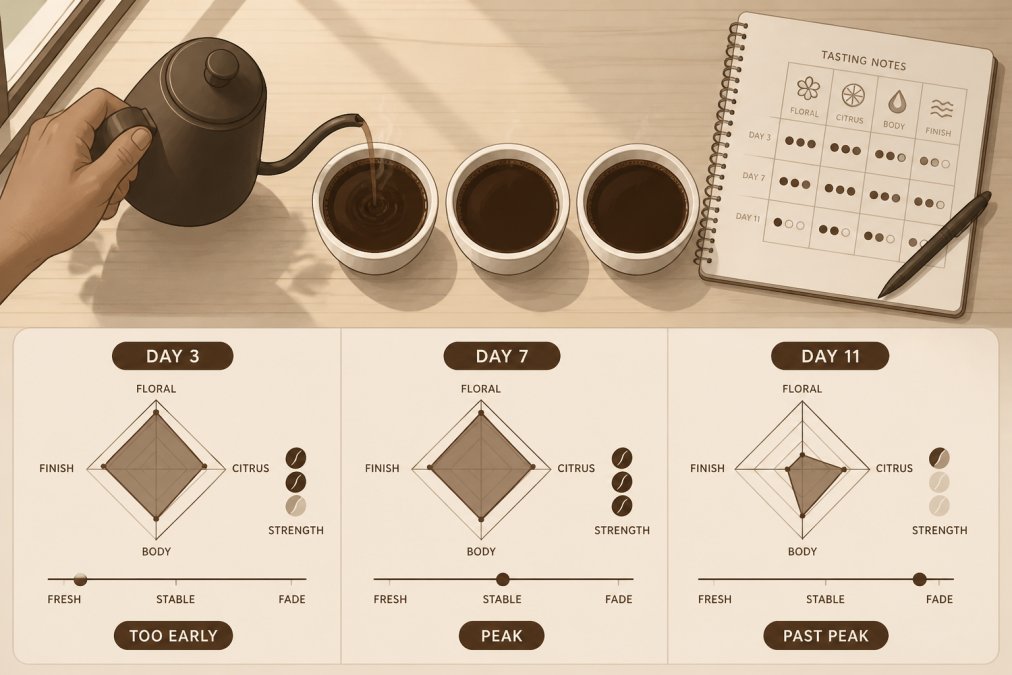
Most guides give you a range and stop. The method below turns that range into a decision for your specific bag, using a simple log you can repeat with every new coffee.
The Three-Cup Protocol
- Lock your variables. Same grinder setting, same water temperature, same dose, same brew time. If you change two things at once, you learn nothing.
- Brew small cups on day 5, day 10, and day 15 after the roast date. Small means 100-150 grams of water per cup, so you're not wasting a full serving.
- Label each cup with the day number so you don't mix them up.
- Smell first, then taste. Aroma tells you more about freshness than flavor does. If the dry grounds smell sweet and the brewed cup smells like cardboard, you've learned something before you sip.
- Score each cup 1-5 for sweetness, aroma, and balance. Write the scores down; memory is a poor judge across days.
- Note the winner. That day number is your peak for this bag.
Your Flavor Log
A notebook page with four columns is enough: date, days since roast, aroma score, and overall score.
This log also settles the degassing-versus-staling question. A cup that scores low on day 5 but climbs by day 10 was degassing. A cup that scores high on day 10 and drops by day 15 is staling. The direction of the scores tells you which problem you have.
Reading the Cup: Degassing vs. Staling
- Still degassing: sharp, gassy, or harsh brightness that softens over days; heavy bloom when water hits the grounds.
- Already staling: flat, papery, or dusty notes that get worse over days; little or no bloom.
If you only brew one cup a week, stretch the schedule to day 7, day 14, and day 21. The principle holds: same method, spaced intervals, written scores.
Conclusion
The hardest part of fresh coffee isn't buying it. It's drinking it at the right moment.
We built Saltwood Coffee around that problem. Every bag is roasted to order, shipped the same day it's roasted, and never sits in standing inventory.
Start the Ritual with a bag of Colombia for a bright, balanced cup, or try the Single Origin Favorites Sample Pack to taste your way to your own peak window.

Frequently Asked Questions
How long after roasting does coffee reach peak flavor?
Most roasted coffee hits its peak flavor roughly 5 to 14 days after the roast date, once the initial burst of carbon dioxide has escaped. Light roasts often need closer to 10 to 14 days, while dark roasts can taste balanced within 5 to 7 days. The exact window depends on the bean, the processing method, and how you brew it. Buying coffee with a clear roast date, like a roast-to-order bag shipped the same day it's roasted, lets you plan your first brew around that window instead of guessing.
How should you store coffee beans to keep them fresh?
Keep whole beans in an airtight container away from light, heat, and moisture, ideally in a cool cupboard rather than the fridge. Oxygen exposure is the main driver of flavor decline, so squeeze excess air out of the bag or use a sealed canister. Buy amounts you will finish within a few weeks, and grind just before brewing. If you order in bulk, split the bag into smaller sealed portions so you open only what you will drink in a week.
Does freshly roasted coffee need to rest before brewing?
Yes, usually. Coffee roasted within the last 24 to 48 hours releases carbon dioxide heavily, which can make espresso run fast and pour-over taste flat or foamy. Giving beans a short resting period, often 3 to 7 days for filter and 7 to 10 for espresso, lets the gas escape and the flavor settle. If a bag arrives days after roasting, it may already be past the heaviest degassing and ready to brew on arrival.
How can you tell if coffee beans are fresh?
Check the roast date first, since a clear date is the most reliable signal. Fresh whole beans smell sweet and layered rather than flat or papery, and they look evenly colored with a slight sheen on darker roasts. When you brew, fresh coffee blooms with gas and bubbles at the start of a pour-over. Stale coffee tastes dull, woody, or sharply bitter. If the bag has no roast date, treat it as a warning sign rather than a guarantee.