

Table of Contents
- What Roast-to-Order Coffee Actually Means
- Peak Freshness: Understanding the Coffee Roast Date and Freshness Window
- Flavor and Aroma You Can't Get from Grocery Store Coffee
- How Long Coffee Beans Stay Fresh and Why It Matters
- How to Store Coffee Beans Properly After Roasting
- Customization and Control Over Your Coffee
- Is Roast-to-Order Worth the Cost?
- Frequently Asked Questions
Last Updated: October 9, 2026
What Roast-to-Order Coffee Actually Means
Roast-to-order coffee is roasted specifically for your order, not weeks or months before you buy it. At Saltwood Coffee, we don't roast your beans until you place your order, then we ship them the same day they're roasted, so the coffee in your cup is fresher than anything on grocery store shelves.
The difference between roast-to-order and pre-roasted coffee is simple. Most coffee you've tried was roasted, packaged, shipped to a distributor, shipped to a store, and sat waiting for you to buy it, a process that takes weeks. With roast-to-order, your coffee goes from roaster to your door in days.
This isn't a marketing gimmick. The moment coffee is roasted, it begins losing its most volatile, flavorful compounds: the aroma fades, the brightness dulls, the complexity flattens. Roast-to-order eliminates that waiting period.
Peak Freshness: Understanding the Coffee Roast Date and Freshness Window
The roast date is the most important number on your coffee bag. It tells you exactly when those beans were roasted and whether you're drinking coffee at its peak or past it.
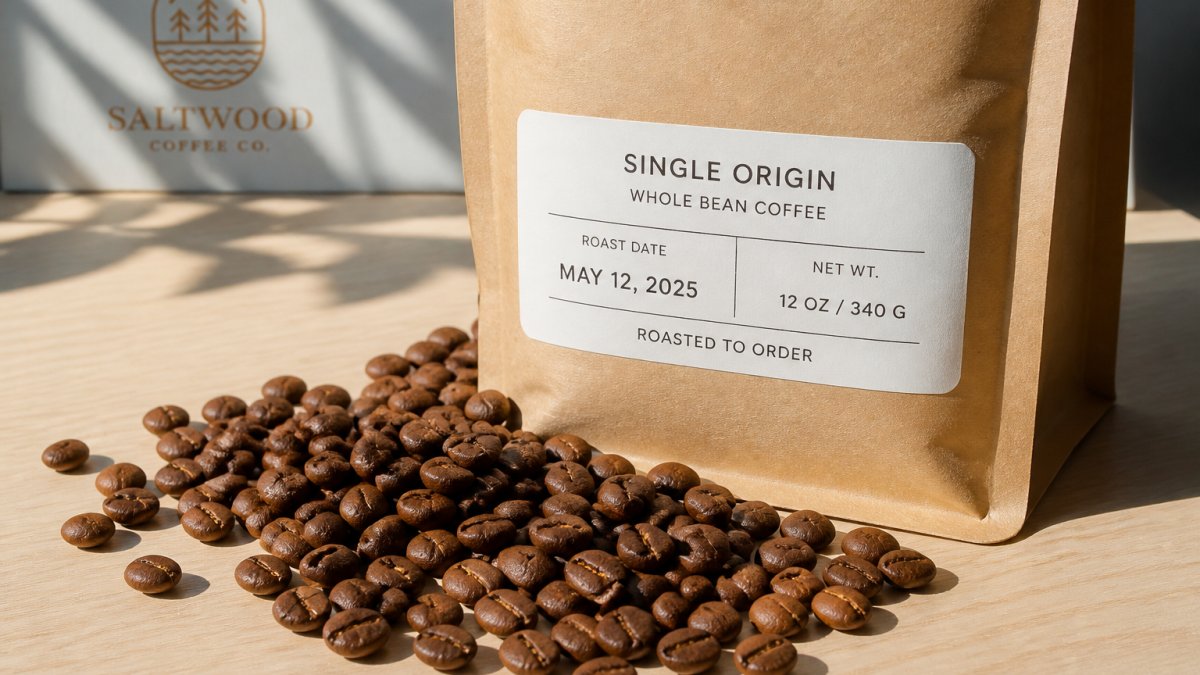
Coffee reaches peak freshness roughly one to six weeks after roasting. During this window, the beans have finished degassing (releasing excess carbon dioxide) but haven't yet begun losing essential oils and flavor compounds to oxidation. This is when the roast profile's full complexity, brightest aroma, and most vibrant taste come through.
Most grocery store coffee has no roast date printed on the bag, intentionally, because you'd realize you're buying month-old beans. With roast-to-order coffee, the roast date is printed right there, so you know exactly how fresh your coffee is.
The freshness window varies slightly by storage conditions and roast level, but the general rule holds: one to six weeks is the best experience.
Flavor and Aroma You Can't Get from Grocery Store Coffee
Freshly roasted coffee tastes noticeably different: more complex aroma, more defined taste profile, cleaner finish. These aren't subtle differences, they're why people switch to roast-to-order and never go back.
Grocery store coffee has sat long enough that most volatile aromatic compounds have oxidized away. What you smell opening that bag is a shadow of the original, and the taste is similarly muted, basic coffee flavor, no nuance.
Freshly roasted coffee from a single-origin bean or crafted blend reveals what the roaster intended: origin characteristics like citrus from an Ethiopian, chocolate and caramel from a Brazilian, floral notes from a Tanzanian. You experience the roast profile as designed, a medium roast balanced and clean, a dark roast full-bodied without bitterness.
Saltwood Coffee's single-origin offerings like Brazil Santos showcase this difference clearly. The tasting profile, elegant, smooth cup with cocoa notes, only comes through when the beans are fresh enough to preserve those delicate flavor compounds. Older coffee loses that elegance and tastes flat.

How Long Coffee Beans Stay Fresh and Why It Matters
Coffee beans stay fresh longest when stored properly, but they decline slowly from the moment they're roasted. Understanding this timeline tells you when to brew and when to finish them.
The first week after roasting, beans are still actively degassing, releasing carbon dioxide that can interfere with extraction and produce a flat cup.
Weeks two through six are when your coffee is at its best: degassing complete, flavor compounds stable, aroma vibrant. This is your target brewing window, and most people finish their coffee during it anyway when ordering roast-to-order.
After six weeks, beans decline noticeably: oxidation accelerates, aroma mutes, taste flattens. The coffee isn't bad, just not what it was.
Storage conditions matter enormously. Coffee in an airtight container in a cool, dark place lasts longer than coffee left open on the counter (Effect of Temperature and Storage on Coffee’s Volatile Compound Profile and Sensory...). Temperature fluctuations and light speed oxidation.
The practical takeaway: roast-to-order coffee arrives during its peak freshness window, so you don't need to worry about it being too old, just store it properly and brew it within a reasonable timeframe.
How to Store Coffee Beans Properly After Roasting
Storage is where a good roast-to-order purchase holds its value or loses it. The beans arrive fresh; what happens next is about limiting oxygen, heat, light, and moisture until you brew.
Use an airtight container with a real seal. A glass jar with a rubber gasket, a ceramic canister with a tight lid, or the original bag with its one-way degassing valve all work. If you transfer beans to a jar, keep the bag's roast-date label with them.
Keep the container in a cool, dark cabinet away from the stove, kettle, and direct sun. Room temperature is fine; the refrigerator is not, because repeated temperature swings introduce moisture that hygroscopic beans absorb.
Grind right before brewing. Whole beans have a much smaller surface area exposed to oxygen than ground coffee, and the flavor difference is noticeable within a day or two of grinding. If you must pre-grind, grind only what you'll use in the next 24 hours.
Buy sizes you'll finish inside the peak window. A 12-ounce bag suits a one-cup-a-day drinker for about three weeks; a two-cup-a-day drinker finishes it in roughly ten days. If you drink less, a sample pack or smaller bag beats a one-pound bag that goes stale before you reach the bottom.
Before you order from any roaster, run a short checklist:
- Roast date, not just 'best by.' A printed roast date tells you exactly how old the beans are. A 'best by' date alone doesn't.
- Roast level. Match the roast to how quickly you'll drink it.
- Origin and processing info. Knowing the origin and process helps you anticipate the flavor curve.
- Packaging. A resealable top is a practical sign the roaster expects the beans to sit for a few days before brewing.
- Shipping cadence. If you subscribe, confirm how often shipments arrive and whether you can pause or skip. A cadence that outpaces your drinking pace creates stale coffee.
- Freshness guarantee.
If you order regularly, a subscription that matches your consumption rate keeps you brewing from beans inside the peak window without stockpiling. If you order occasionally, buy smaller and more often rather than larger and less often.
Customization and Control Over Your Coffee
Roast-to-order coffee gives you control grocery store coffee never can: you choose the roast level, the origin or blend, and whether you want a flavored option or a pure single-origin experience.
This matters because coffee preferences are personal: some love a light roast's brightness, others a dark roast's body and richness, others a medium roast's balance. Roast-to-order roasters accommodate all three in the same order.
Single-origin coffee lets you explore how geography and processing shape flavor. Roast-to-order gives you that variety without settling for a generic house blend.
Flavored options add another layer of customization. Saltwood Coffee's flavored coffees, like Mint, French Vanilla, Hazelnut, and Mocha, are flavored while the beans are still warm after roasting. You get the coffee flavor you want, customized to your taste.
Customization extends to frequency: order once or set up a subscription matching your consumption rate. You control when coffee arrives and avoid the feast-or-famine cycle of running out and overbuying.
Is Roast-to-Order Worth the Cost?
Roast-to-order coffee usually costs more than supermarket coffee. The useful question isn't whether it costs more, but whether cost per cup, shipping terms, and waste make it worth it for how you actually drink coffee.
Start with cost per cup, not cost per bag. A standard 12-ounce bag of whole-bean coffee yields roughly 16 to 20 cups at a typical 18-20 gram dose, depending on your brew method. A $20 bag lands near $1.00-$1.25 per cup; a $25 bag lands near $1.25-$1.55 per cup. Supermarket coffee often runs $0.40-$0.80 per cup, and single-serve pods frequently run $0.50-$1.00 per cup once you account for packaging.
Shipping is the variable most buyers forget. Some roasters fold shipping into the bag price; others charge per order. Ordering two or three bags per shipment, or choosing a subscription with free or flat-rate shipping, usually brings the per-cup cost back in line. Read the subscription terms before committing: check the minimum order count, the cancellation window, and whether the roast date is guaranteed on every shipment.
Waste is the quieter cost. Supermarket coffee that goes stale before you finish it is money thrown away, a common pattern is buying a large tub, drinking half fresh, and finishing the rest out of habit. Roast-to-order lets you size orders to your consumption rate, so less ends up in the compost. Matching bag size to your pace is the single biggest lever on value.
Where roast-to-order is clearly worth it: you drink coffee daily, you care about flavor, and you're willing to spend a few extra dollars per week for beans that arrive within days of roasting. Where it's harder to justify: you drink coffee occasionally, you're happy with a mid-tier supermarket brand, or you don't want to manage shipping cadence and storage. Neither answer is wrong, the point is to run the per-cup math against your own habits before deciding.
A quick value test: buy one bag, track how many cups you get, and note whether the last cup tastes as good as the first. If yes and the per-cup number fits your budget, roast-to-order is doing its job. If the last cup tastes flat, the problem is usually bag size or storage, not the concept.
Frequently Asked Questions
What does roast-to-order coffee mean?
Roast-to-order means your coffee is roasted only after you place your order, then shipped the same day it's roasted. Unlike grocery store coffee that sits in inventory for weeks or months, roast-to-order coffee goes from roaster to your door within days. This process captures the full flavor and aroma at peak freshness, eliminating the degradation that happens during long storage. The roast date appears on your bag, so you know exactly how fresh your coffee is when it arrives.
How long do whole coffee beans stay fresh after roasting?
Whole coffee beans reach peak freshness between one and six weeks after roasting. The first few days after roasting, the beans are still degassing and releasing CO2, which can affect extraction. They remain drinkable for several months if stored properly in an airtight container away from light and heat, but the complexity and brightness fade noticeably after six weeks. For the best taste, brew your roast-to-order coffee within the first month.
How should you store freshly roasted coffee beans to keep them fresh?
Store whole beans in an airtight container away from direct sunlight, heat, and moisture. Glass jars with tight seals or dedicated coffee canisters work well. Keep them at room temperature, never in the refrigerator or freezer, as temperature fluctuations cause condensation that damages the beans. Once opened, transfer beans to an airtight container within a few days. Proper storage extends your freshness window and preserves the subtle flavor notes roasted into your beans.
Is roast-to-order coffee worth the extra cost compared to grocery store coffee?
The difference in taste is noticeable if you care about flavor. Roast-to-order coffee at $24.99 per bag delivers complexity, brightness, and aroma that grocery store beans, often months old, simply cannot match. You also control the roast level and bean origin, which grocery stores don't offer. The trade-off is price and convenience: roast-to-order costs more and requires planning ahead. For remote workers building a morning ritual or coffee enthusiasts who appreciate quality, the investment pays off in every cup. For casual drinkers, it may feel like overkill.